
One of the fastest ways to get overwhelmed is to try to build everything at once.
A lot of people start with a big vision. They want a full platform, a full app, a full plugin, a full membership system, or a full software business. The vision is exciting, but the size of it can also freeze them.
They look at the whole thing and think, “I have no idea where to start.”
That is normal.
Big ideas are exciting. However, big ideas are also dangerous if you do not know how to break them down.
That is why one of the most important skills in vibe coding is learning how to take a large idea and turn it into smaller, manageable parts.
This changes everything.
Big Ideas Are Not the Problem
Having a big idea is not a bad thing.
In fact, big ideas are often what push people to build in the first place.
Maybe you want to create:
-
a membership platform
-
a custom WordPress plugin
-
a SaaS product
-
a client dashboard
-
a booking system
-
a course platform
-
a lead generation tool
-
a niche business app
Those are real ideas. They matter.
The problem is not the size of the idea.
The problem is trying to build the entire thing in one mental step.
When that happens, everything feels too heavy. You do not know what to ask for first. You do not know which feature matters most. You do not know how the pieces fit together. So instead of building, you stall.
That is why breakdown matters so much.
Builders Think in Pieces
A builder does not only look at the finished dream.
A builder looks at the pieces that create it.
For example, if someone says, “I want to build a membership platform,” that is still too large to work with directly.
A builder starts asking:
-
What pages does it need?
-
Who are the users?
-
How do they sign up?
-
What happens after login?
-
What content is protected?
-
What roles exist?
-
What features matter first?
-
What can wait until later?
Now the project starts becoming workable.
Instead of one giant unclear idea, you now have smaller parts that can be planned, prompted, tested, and improved.
That is how real progress begins.
Break the Build Into Core Categories
One of the easiest ways to break a project down is to think in categories.
For most software projects, the categories often look something like this:
Pages
What pages or screens need to exist?
For example:
-
home page
-
pricing page
-
login page
-
dashboard page
-
settings page
-
admin page
-
checkout page
Features
What should the system actually do?
For example:
-
user registration
-
profile editing
-
file uploads
-
payment processing
-
AI generation
-
search
-
filtering
-
notifications
Users
Who is using the system, and what should they be allowed to do?
For example:
-
guest users
-
logged-in users
-
paid members
-
admins
-
instructors
-
clients
-
team members
Data
What needs to be stored?
For example:
-
user information
-
account settings
-
generated content
-
payments
-
project records
-
course progress
-
saved prompts
Logic
What needs to happen behind the scenes?
For example:
-
saving to the database
-
checking permissions
-
validating form data
-
connecting to Stripe
-
showing different content by role
-
triggering emails
-
handling failed actions
Once you start looking at a big project this way, it becomes much easier to work with.
Start With the Minimum Working Version
This is one of the most important parts of the lesson.
When breaking a project down, do not start by planning the biggest version possible.
Start by asking:
What is the smallest version that still works?
That question helps you find your first real build.
For example, instead of:
“I want a full SaaS platform with subscriptions, dashboards, analytics, AI tools, support tickets, and team accounts,”
you might begin with:
“I want users to create an account, log in, and access one working tool.”
That is much more manageable.
Then later, you can add:
-
subscriptions
-
better dashboards
-
saved history
-
settings
-
permissions
-
more tools
-
upgrades
-
analytics
This is how many strong products are built.
They do not begin with every feature.
They begin with one working core.
Smaller Parts Create Better Prompts
Breaking big ideas into smaller pieces also makes ChatGPT much more useful.
Why?
Because AI works better when the task is clear.
If you ask:
“Build me a full platform,”
you will usually get something vague, bloated, incomplete, or unrealistic.
However, if you ask:
“Create a WordPress shortcode that shows a logged-in user dashboard with a welcome message and links to three tools,”
the result becomes much more focused.
Smaller prompts lead to:
-
clearer output
-
less confusion
-
easier testing
-
faster progress
-
better revisions
This is a major mindset shift.
Do not prompt the dream all at once.
Prompt the next part.
Breaking Things Down Reduces Fear
Big projects often create fear because the brain sees them as one giant mountain.
Once you break the mountain into steps, it becomes easier to move.
Instead of thinking:
“I have to build everything,”
you start thinking:
“I need to build this one part next.”
That is a huge difference.
It lowers pressure.
It makes progress visible.
It helps you stay calm when the larger vision still feels far away.
And most importantly, it gives you something real to do today.
That is how momentum is built.
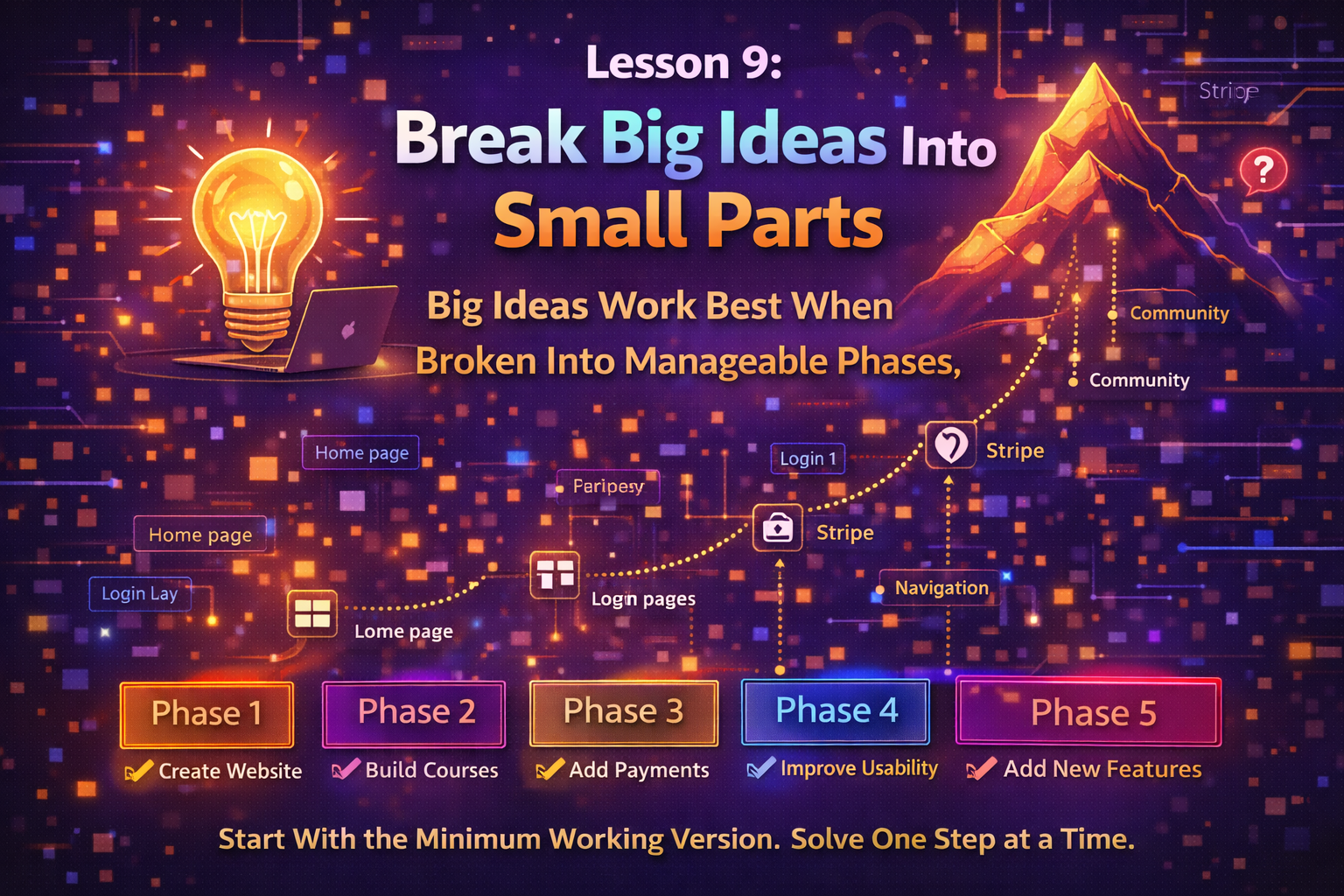
A Good Breakdown Might Look Like This
Let’s say your big idea is a course platform.
A rough breakdown could look like this:
Phase 1
-
create the website
-
install WordPress
-
choose the course system
-
create login and registration
-
set up the dashboard
Phase 2
-
create course pages
-
add lesson structure
-
upload images
-
organize modules
-
test student access
Phase 3
-
add payments
-
connect Stripe
-
set pricing
-
test enrollment flow
-
protect premium content
Phase 4
-
improve user roles
-
create better navigation
-
build support pages
-
improve design
-
optimize for mobile
Phase 5
-
add advanced features
-
custom dashboards
-
community tools
-
analytics
-
automations
-
additional security checks
That is a lot easier to work with than simply saying:
“I want to build a full learning platform.”
You Do Not Need the Perfect Plan First
This part matters too.
Breaking a project into smaller parts does not mean you need a perfect roadmap from day one.
You do not.
Sometimes the breakdown becomes clearer only after you start.
That is okay.
The goal is not perfect planning.
The goal is enough structure to begin intelligently.
You can always revise the plan later.
In fact, that is normal.
You may build one feature and realize the next step has changed. You may test something and discover a better direction. You may cut features. You may simplify. You may improve the order.
That is part of the process.
This Is How Big Things Actually Get Built
People often admire finished products without seeing how many small decisions built them.
A working platform may look impressive at the end. However, it was almost never created as one giant move.
It was built through parts.
One page.
One feature.
One test.
One fix.
One improvement.
One version at a time.
That is why this lesson matters so much.
If you learn how to break things down, you become much harder to stop.
Because even when the vision is big, the next step stays small enough to handle.
Final Thoughts
Big ideas are exciting.
However, they only become real when you break them into smaller parts.
That means thinking in pages, features, users, data, logic, and phases.
It means finding the minimum working version.
It means focusing on the next part, not the entire mountain at once.
It means giving ChatGPT smaller, clearer tasks so you can get better results.
That is how you move from feeling overwhelmed to actually building.
And that is how big visions slowly become real products.