
A lot of people think vibe coding is mostly about prompting.
They think the main skill is knowing what to type into ChatGPT so it gives back useful code.
Prompting does matter. However, it is not the deepest skill.
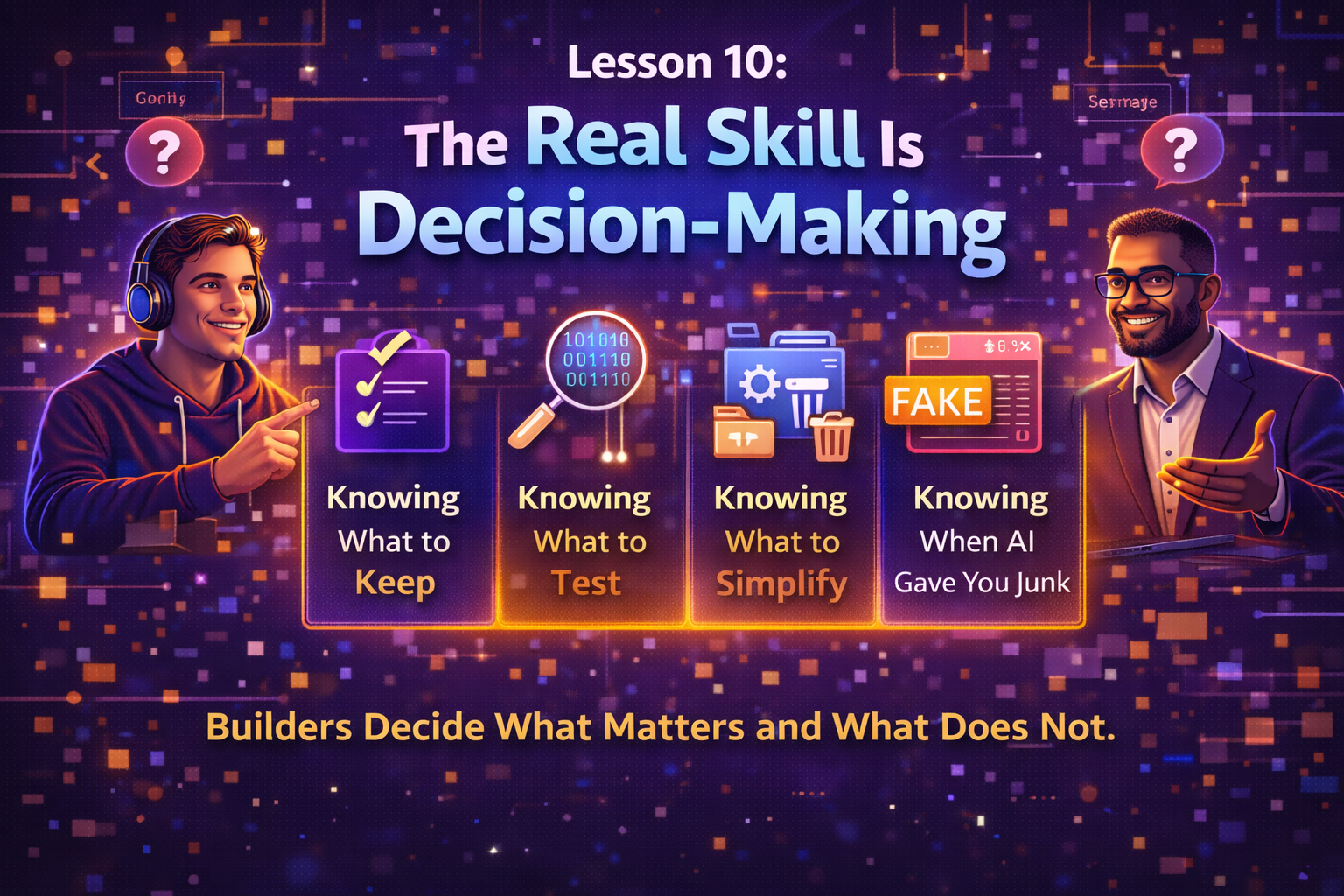
The real skill is decision-making.
That is what separates people who stay stuck from people who actually build useful things.
Because once ChatGPT gives you ideas, code, revisions, options, and explanations, you still have to decide what happens next.
You have to decide:
-
what to keep
-
what to test
-
what to simplify
-
when AI gave you junk
That is where real builders start to stand out.
AI Can Generate, but You Still Have to Decide
ChatGPT can give you:
-
a starting point
-
multiple versions
-
suggestions
-
rewrites
-
explanations
-
workflows
-
code structures
That is helpful. However, none of that removes the need for judgment.
In fact, AI often creates more decisions, not fewer.
You may get:
-
two different ways to build the same feature
-
code that mostly works but feels too bloated
-
a solution that is technically possible but too complicated
-
an answer that sounds smart but does not fit your actual goal
That means your job is not just to receive output.
Your job is to evaluate it.
That is why decision-making matters so much.
Knowing What to Keep
Not everything ChatGPT gives you should stay.
Sometimes AI gives you one useful part and three unnecessary parts.
Sometimes it gives you a good structure but weak wording.
Sometimes it gives you logic that works, but it adds too much extra code around it.
A builder has to look at the output and ask:
-
Does this actually help the project?
-
Does this match the goal?
-
Is this part useful?
-
Is this improving the build or just making it bigger?
That is how you learn what to keep.
You keep the parts that:
-
move the project forward
-
match the real goal
-
are understandable enough to work with
-
improve the build without adding confusion
This matters because bad builders keep everything.
Good builders filter.
Knowing What to Test
Testing is not random.
You do not just click around and hope for the best.
A strong builder knows what matters most and tests those parts first.
For example, if you build a form, you should test:
-
does it submit
-
does it save correctly
-
does it reject bad data
-
does it work for the right user
-
does it fail safely
If you build a payment flow, you should test:
-
does checkout load
-
does payment go through
-
does the user get access after payment
-
what happens when payment fails
-
what happens when the wrong user tries to access it
If you build a user dashboard, you should test:
-
can the right user see it
-
can the wrong user see it
-
do the buttons work
-
do the links go where they should
-
is the information correct
This is decision-making too.
You are deciding what parts are risky, what parts matter most, and what needs proof before moving on.
Knowing What to Simplify
One of the most common problems with AI-generated work is that it often gives you more than you need.
That happens all the time.
You ask for something small, and AI gives you:
-
extra features
-
too many options
-
unnecessary complexity
-
too much code
-
too many moving parts
-
logic that is harder to maintain than it should be
That is where simplification becomes a real skill.
A builder has to ask:
-
Can this be smaller?
-
Can this be clearer?
-
Do I really need all of this?
-
What is the simplest version that still works?
Simplifying is powerful because simpler systems are usually:
-
easier to test
-
easier to understand
-
easier to debug
-
easier to improve later
Many beginners think bigger means better.
Usually, cleaner is better.
Knowing When AI Gave You Junk
This is one of the most important skills in vibe coding.
Sometimes AI gives you junk.
Not because it is useless overall, but because it is still capable of guessing, overcomplicating, misunderstanding, or inventing things that do not belong.
Junk can look like:
-
fake functions
-
made-up file names
-
code that does not match your platform
-
logic that breaks the real workflow
-
insecure handling of users or data
-
bloated code for a very small feature
-
answers that sound confident but do not solve the actual problem
This is where beginners can get trapped.
They assume that if it looks smart, it must be right.
That is not always true.
So you need to learn to ask:
-
Does this actually make sense?
-
Does this match my setup?
-
Does this solve the real issue?
-
Is this too complicated for what I asked?
-
Did AI just give me something that sounds good but is not useful?
That skill will save you a huge amount of time.
Decision-Making Is What Turns AI Into a Real Tool
Without decision-making, AI becomes noisy.
You get too many ideas, too many versions, too much code, and too many directions.
With decision-making, AI becomes useful.
Because now you can:
-
filter the output
-
choose the better path
-
cut what does not matter
-
focus on what needs testing
-
simplify what got too messy
-
reject the junk and keep moving
That is the difference.
AI gives possibilities.
You create direction.
Builders Make Small Decisions Constantly
A lot of people think decision-making means huge dramatic choices.
Sometimes it does. However, most of the time it is smaller than that.
It looks like:
-
choosing one version over another
-
deciding not to add a feature yet
-
cutting extra code
-
testing one small function before moving on
-
deciding a form needs validation
-
realizing a workflow is too confusing
-
rewriting a prompt to get a better result
-
choosing clarity over complexity
These small decisions shape the whole project.
That is why the real skill is not just prompting once.
It is guiding the project through better choices over and over again.
Better Decisions Come From Clear Goals
Decision-making gets easier when your goal is clear.
If you know:
-
what you are building
-
who it is for
-
what problem it solves
-
what version you are on
-
what matters most right now
then it becomes easier to judge what belongs and what does not.
Without a clear goal, everything feels possible, and that becomes a problem.
You end up with:
-
too many features
-
too many prompts
-
too much code
-
too many changes
-
too little focus
That is why builder thinking and decision-making go together.
Clear goals lead to better decisions.
This Is One of the Biggest Skills You Will Build Over Time
You do not become great at this overnight.
At first, you may keep things you should cut.
At first, you may test the wrong thing first.
At first, you may trust output that turns out to be junk.
That is normal.
Over time, you get better.
You start to notice patterns.
You start to recognize when something feels bloated.
You start to catch weak logic faster.
You start to see which steps matter most.
That growth is part of becoming a real builder.
Final Thoughts
The real skill in vibe coding is decision-making.
It is knowing:
-
what to keep
-
what to test
-
what to simplify
-
when AI gave you junk
That is what helps you move from generating random output to creating something real and useful.
ChatGPT can help you move faster. However, your decisions are what shape the final result.
That is why decision-making matters so much.
It is one of the deepest skills in this whole process.