
One of the biggest mistakes people make with AI is thinking that success comes from prompting alone.
They believe the whole job is just typing requests into ChatGPT and waiting for something useful to appear.
That is not enough.
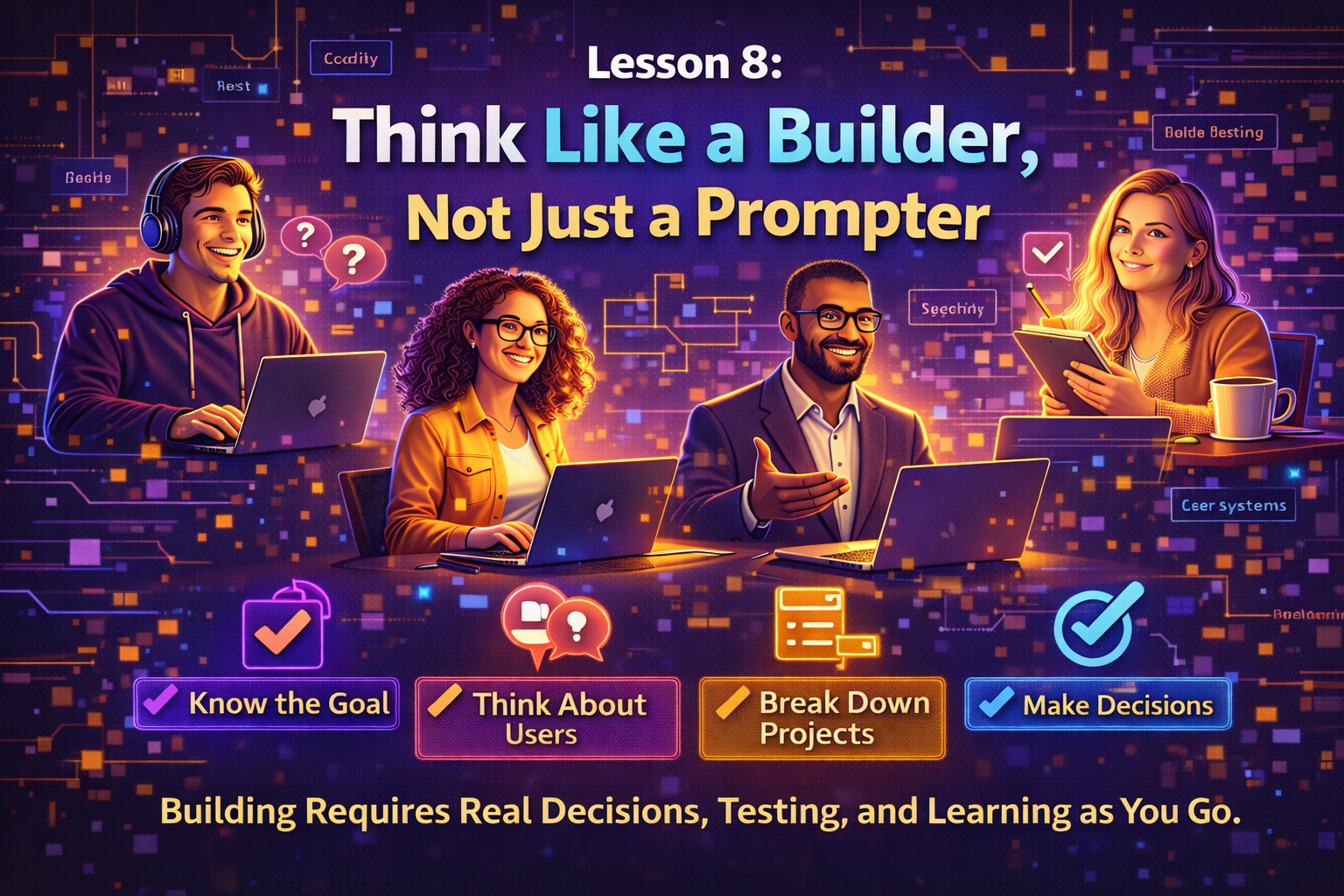
If you want real results, you have to think like a builder.
A builder does not just ask for things. A builder makes decisions. A builder thinks about the goal, the user, the structure, the workflow, the problems, and the outcome. A builder does not only focus on what to type next. A builder focuses on what they are actually trying to create.
That difference matters more than most people realize.
Prompting Is a Tool, Not the Whole Skill
Prompts matter. Of course they do.
The better your prompts are, the better your results usually become.
However, prompting is only one part of the process.
If you only think like a prompter, you may keep asking for random pieces without understanding how they connect. You may get code, revisions, layouts, and ideas, but still end up with something messy, bloated, or broken.
That happens because prompts alone do not create strong products.
Good products come from good thinking.
That means you need to think about:
-
what the project is supposed to do
-
who it is for
-
what problem it solves
-
what the simplest version should be
-
what needs to happen first
-
what can wait until later
Those are builder questions.
And those questions shape everything that comes after.
A Builder Starts With the Goal
Before you ask AI for code, you should know what you are trying to build.
Not every tiny detail. However, you should know the main goal.
For example:
-
Is this a tool?
-
Is this a plugin?
-
Is this a membership feature?
-
Is this a user dashboard?
-
Is this a payment flow?
-
Is this a small prototype?
-
Is this a business system?
If the goal is unclear, the build usually becomes unclear too.
A builder starts by asking:
-
What is the end result?
-
What should this do?
-
What should happen when a user interacts with it?
-
What does success look like?
Once that goal is clear, prompts become much more useful because they are aimed at something specific.
A Builder Thinks About the User
Prompting can become very self-focused if you are not careful.
You may get caught up asking for code without thinking about the person who will actually use what you are building.
Builders think about users.
They ask:
-
Who is this for?
-
What do they need?
-
What do they expect?
-
What would confuse them?
-
What should be simple?
-
What should happen after they click this?
-
What information do they need to see?
This matters because software is not just about code. It is about experience.
You can have technically working code and still have a poor product if the user flow is confusing or frustrating.
That is why builders think beyond the prompt.
They think about the human being on the other side of the screen.
A Builder Breaks Big Ideas Into Smaller Parts
A prompter may say:
“Build me a full SaaS platform with memberships, payments, dashboards, AI tools, and admin controls.”
A builder knows that is too big to start with all at once.
A builder breaks the idea down.
For example:
-
user registration
-
login flow
-
database structure
-
dashboard layout
-
payment setup
-
role permissions
-
settings page
-
first core feature
-
testing process
This is a much smarter way to work.
When you break a project into smaller parts:
-
prompts get clearer
-
errors are easier to catch
-
progress is easier to track
-
the build feels less overwhelming
-
the final result becomes more manageable
Big things get built through smaller pieces.
That is a builder mindset.
A Builder Makes Decisions
AI can generate options. However, it does not make the final decision for you.
That part belongs to you.
Builders decide:
-
which version is better
-
which feature matters now
-
which code should be simplified
-
which ideas should be cut
-
which workflows make sense
-
which risks need more attention
-
which parts need more testing
This is very important because AI will often give you something usable, but not necessarily something ideal.
Sometimes it gives too much.
Sometimes it makes the solution more complicated than it needs to be.
Sometimes it misses the real point.
A builder reviews what comes back and says:
-
keep this
-
remove that
-
simplify this
-
fix this
-
make this safer
-
make this easier for users
That decision-making is one of the real skills behind vibe coding.
A Builder Thinks in Versions
A prompter may want everything finished immediately.
A builder understands versions.
Version 1 does not need to do everything.
Version 1 needs to work.
Then version 2 can improve it.
Then version 3 can expand it.
This matters because trying to build the perfect final version too early often slows everything down.
Builders think like this:
-
What is the smallest working version?
-
What is the first real win?
-
What can I test now?
-
What can I improve later?
This keeps momentum alive.
It also reduces frustration because you stop demanding perfection from the very beginning.
A Builder Tests, Not Just Generates
A prompter may think the job ends when ChatGPT gives an answer.
A builder knows the real work continues after that.
Builders test.
They test:
-
whether the code runs
-
whether the feature behaves correctly
-
whether the form submits
-
whether the database stores data
-
whether the user role blocks access correctly
-
whether the payment flow works
-
whether the page makes sense to the user
This is where real progress happens.
Generated code is just the start.
Testing turns a guess into something real.
That is why builder thinking is so important. It moves you beyond the excitement of generation and into the reality of creating something that actually works.
A Builder Learns From Problems
When something breaks, a prompter may panic.
A builder treats problems as part of the process.
Builders understand that bugs, errors, and confusion are not proof that they failed. They are part of building.
So instead of quitting, they ask:
-
What broke?
-
Why did it break?
-
What changed?
-
What did I expect to happen?
-
What is the smallest thing I can test next?
That mindset is powerful.
It turns setbacks into learning.
And over time, that makes you much more capable.
This Platform Is Building Builders
That is one of the biggest goals of this entire learning platform.
We are not trying to create people who can only copy prompts.
We are trying to create people who can think clearly, build step by step, solve problems, and grow into real software builders over time.
That means learning how to:
-
think about goals
-
think about users
-
plan features
-
break down projects
-
test properly
-
handle revisions
-
improve security
-
understand structure
-
keep building when things get hard
Prompting is part of that.
But it is not the whole thing.
The bigger goal is to help you think and work like a builder.
Final Thoughts
So, think like a builder, not just a prompter.
Use prompts, yes. However, do not stop there.
Know the goal.
Think about the user.
Break projects into parts.
Make decisions.
Build in versions.
Test what you create.
Learn from what breaks.
That is how you move from simply asking AI for things to actually creating something real.
And that is where vibe coding becomes truly powerful.